
Note
Go to the end to download the full example code
CatBoost optimization example#
A simple example showing hyperparameter optimization for CatBoost Classifier with genetic algorithms.
from sklearn.datasets import load_breast_cancer
from sklearn.model_selection import train_test_split
from sklearn.metrics import accuracy_score, precision_score, recall_score, f1_score
from catboost import CatBoostClassifier
import plotly
import os
from mloptimizer.interfaces import HyperparameterSpaceBuilder, GeneticSearch
from mloptimizer.application.reporting.plots import (plotly_search_space, plotly_logbook,
                                                     plot_logbook)
import matplotlib.pyplot as plt
Load and prepare the dataset#
Loading Breast Cancer dataset...
Dataset shape: (569, 30)
Number of classes: 2
Split the data
Define the CatBoost hyperparameter space#
CatBoost has specific hyperparameters that differ from other gradient boosting libraries. We can use the default hyperparameter space or build a custom one.
Option 1: Load default space (recommended for quick start)
hyperparam_space = HyperparameterSpaceBuilder.get_default_space(
    estimator_class=CatBoostClassifier
)

# Option 2: Build custom space (uncomment to use)
# hyperparam_space = (HyperparameterSpaceBuilder()
#                     .add_int_param('depth', min_value=4, max_value=10)
#                     .add_float_param('learning_rate', min_value=1, max_value=10, scale=100)
#                     .add_int_param('iterations', min_value=50, max_value=200)
#                     .add_float_param('subsample', min_value=700, max_value=1000, scale=1000)
#                     .set_fixed_param('verbose', False)
#                     .build())

print("\nHyperparameter space configuration:")
print(f"Evolvable parameters: {list(hyperparam_space.evolvable_hyperparams.keys())}")
print(f"Fixed parameters: {list(hyperparam_space.fixed_hyperparams.keys())}")
Hyperparameter space configuration:
Evolvable parameters: ['learning_rate', 'depth', 'n_estimators', 'subsample', 'l2_leaf_reg', 'colsample_bylevel', 'random_strength']
Fixed parameters: ['auto_class_weights', 'bootstrap_type', 'allow_writing_files', 'verbose', 'thread_count']
Configure and run the genetic optimization#
Genetic Algorithm Configuration: - generations: Number of evolutionary iterations - population_size: Number of configurations per generation - n_elites: Number of best individuals preserved each generation - seed: Random seed for reproducibility Note: Small values for faster documentation builds. For production, increase to 20+ generations.
genetic_params = {
    'generations': 5,
    'population_size': 8,
    'n_elites': 2,
    'seed': 42,
    'use_parallel': False
}

opt = GeneticSearch(
    estimator_class=CatBoostClassifier,
    hyperparam_space=hyperparam_space,
    cv=3,
    scoring='accuracy',
    disable_file_output=False,
    **genetic_params
)

print("\nStarting CatBoost optimization...")
print(f"Generations: {opt.generations}")
print(f"Population size: {opt.population_size}")

# Run the optimization
opt.fit(X_train, y_train)
/home/docs/checkouts/readthedocs.org/user_builds/mloptimizer/checkouts/master/examples/plot_catboost_example.py:76: UserWarning: Some hyperparameters have very small integer ranges (< 10 distinct values): 'depth' (7 values: 4 to 10). Small ranges limit search granularity. Consider increasing the range or scale for float types.
  opt = GeneticSearch(

Starting CatBoost optimization...
Generations: 5
Population size: 8

Genetic execution:   0%|          | 0/6 [00:00<?, ?it/s, best fitness=?]
Genetic execution:  17%|█▋        | 1/6 [00:05<00:25,  5.20s/it, best fitness=0.974]
Genetic execution:  17%|█▋        | 1/6 [00:06<00:34,  6.86s/it, best fitness=0.976]
Genetic execution:  17%|█▋        | 1/6 [00:40<03:20, 40.19s/it, best fitness=0.978]
Genetic execution:  17%|█▋        | 1/6 [00:53<04:25, 53.03s/it, best fitness=0.978]
Genetic execution:  33%|███▎      | 2/6 [00:53<01:46, 26.51s/it, best fitness=0.978]
Genetic execution:  33%|███▎      | 2/6 [01:18<01:46, 26.51s/it, best fitness=0.98]
Genetic execution:  50%|█████     | 3/6 [01:22<01:23, 27.84s/it, best fitness=0.98]
Genetic execution:  67%|██████▋   | 4/6 [01:29<00:39, 19.86s/it, best fitness=0.98]
Genetic execution:  67%|██████▋   | 4/6 [01:32<00:39, 19.86s/it, best fitness=0.982]
Genetic execution:  83%|████████▎ | 5/6 [01:35<00:15, 15.01s/it, best fitness=0.982]
Genetic execution: 100%|██████████| 6/6 [01:42<00:00, 12.38s/it, best fitness=0.982]
Genetic execution: 100%|██████████| 6/6 [01:48<00:00, 18.15s/it, best fitness=0.982]
/home/docs/checkouts/readthedocs.org/user_builds/mloptimizer/envs/master/lib/python3.11/site-packages/seaborn/_oldcore.py:1119: FutureWarning: use_inf_as_na option is deprecated and will be removed in a future version. Convert inf values to NaN before operating instead.
  with pd.option_context('mode.use_inf_as_na', True):
/home/docs/checkouts/readthedocs.org/user_builds/mloptimizer/envs/master/lib/python3.11/site-packages/seaborn/_oldcore.py:1119: FutureWarning: use_inf_as_na option is deprecated and will be removed in a future version. Convert inf values to NaN before operating instead.
  with pd.option_context('mode.use_inf_as_na', True):
Get results and evaluate
best_clf = opt.best_estimator_
y_pred = best_clf.predict(X_test)
test_accuracy = accuracy_score(y_test, y_pred)
precision = precision_score(y_test, y_pred, average='binary')
recall = recall_score(y_test, y_pred, average='binary')
f1 = f1_score(y_test, y_pred, average='binary')

print(f"\nOptimization completed!")
print(f"Best hyperparameters: {opt.best_params_}")
print(f"\nTest performance:")
print(f"  Accuracy:  {test_accuracy:.4f}")
print(f"  Precision: {precision:.4f}")
print(f"  Recall:    {recall:.4f}")
print(f"  F1 Score:  {f1:.4f}")
Optimization completed!
Best hyperparameters: {'learning_rate': 0.02, 'depth': 4, 'l2_leaf_reg': 5, 'thread_count': 1, 'verbose': False, 'auto_class_weights': 'Balanced', 'random_strength': 8, 'allow_writing_files': False, 'bootstrap_type': 'Bernoulli', 'subsample': 0.835, 'n_estimators': 479, 'colsample_bylevel': 0.86, 'random_state': 42}

Test performance:
  Accuracy:  0.9649
  Precision: 0.9722
  Recall:    0.9722
  F1 Score:  0.9722
Generate visualizations
population_df = opt.populations_

# Search space visualization
top_params = ['depth', 'learning_rate', 'n_estimators', 'l2_leaf_reg', 'fitness']
df_filtered = population_df[top_params]
g_search_space = plotly_search_space(df_filtered, top_params)
g_search_space.update_layout(
    title="CatBoost Hyperparameter Search Space - Breast Cancer Dataset",
    autosize=True,
    width=None,
    height=650
)
plotly.io.show(g_search_space, config={'responsive': True})
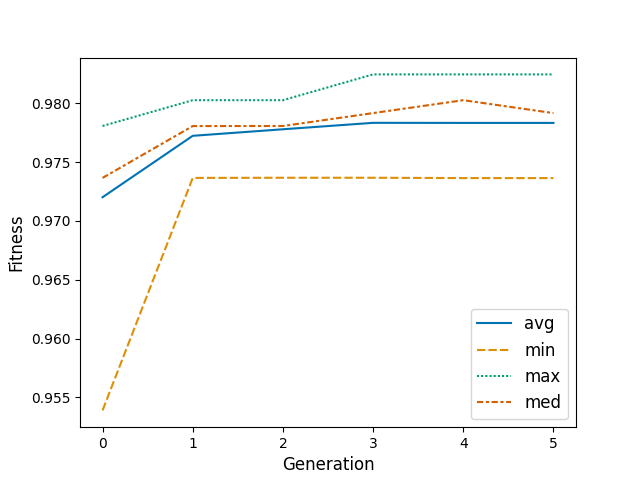
Simple logbook visualization
g_logbook_s = plot_logbook(opt.logbook_)
# plt.show()  # Commented out for non-interactive environments
/home/docs/checkouts/readthedocs.org/user_builds/mloptimizer/envs/master/lib/python3.11/site-packages/seaborn/_oldcore.py:1119: FutureWarning: use_inf_as_na option is deprecated and will be removed in a future version. Convert inf values to NaN before operating instead.
  with pd.option_context('mode.use_inf_as_na', True):
/home/docs/checkouts/readthedocs.org/user_builds/mloptimizer/envs/master/lib/python3.11/site-packages/seaborn/_oldcore.py:1119: FutureWarning: use_inf_as_na option is deprecated and will be removed in a future version. Convert inf values to NaN before operating instead.
  with pd.option_context('mode.use_inf_as_na', True):
Evolution logbook visualization
g_logbook = plotly_logbook(opt.logbook_, population_df)
g_logbook.update_layout(
    title="CatBoost Optimization Evolution - Breast Cancer Dataset",
    autosize=True,
    width=None,
    height=500
)
plotly.io.show(g_logbook, config={'responsive': True})
Analyze optimization results
print("\n=== Optimization Analysis ===")
print(f"Unique evaluations performed: {opt.n_trials_}")
print(f"Total individuals in population history: {len(population_df)}")
print(f"Optimization time: {opt.optimization_time_:.4f} seconds")
print(f"Time per evaluation: {opt.optimization_time_ / opt.n_trials_:.4f} seconds")
print(f"Generations completed: {opt.generations}")

final_gen = population_df[population_df['population'] == opt.generations]
initial_gen = population_df[population_df['population'] == 1]

final_avg_fitness = final_gen['fitness'].mean()
initial_avg_fitness = initial_gen['fitness'].mean()
improvement = final_avg_fitness - initial_avg_fitness

print(f"\nFitness progression:")
print(f"  Initial average fitness: {initial_avg_fitness:.4f}")
print(f"  Final average fitness:   {final_avg_fitness:.4f}")
print(f"  Average improvement:     {improvement:.4f}")
=== Optimization Analysis ===
Unique evaluations performed: 28
Total individuals in population history: 48
Optimization time: 109.3850 seconds
Time per evaluation: 3.9066 seconds
Generations completed: 5

Fitness progression:
  Initial average fitness: 0.9772
  Final average fitness:   0.9783
  Average improvement:     0.0011
Access generated files
print("\n=== Generated Files ===")
graphics_path = opt._optimizer_service.optimizer.tracker.graphics_path
results_path = opt._optimizer_service.optimizer.tracker.results_path

print(f"Graphics path: {graphics_path}")
if os.path.exists(graphics_path):
    print("  Graphics files:", [f for f in os.listdir(graphics_path) if f.endswith('.html')])

print(f"Results path: {results_path}")
if os.path.exists(results_path):
    print("  Results files:", [f for f in os.listdir(results_path) if f.endswith('.csv')])
=== Generated Files ===
Graphics path: ./20260406_230846_CatBoostClassifier/graphics
  Graphics files: ['logbook.html', 'search_space.html']
Results path: ./20260406_230846_CatBoostClassifier/results
  Results files: ['logbook.csv', 'populations.csv']
CatBoost-specific features#
CatBoost offers several unique features:
Automatic handling of categorical features: No need for manual encoding
Balanced class weights: Set via auto_class_weights=’Balanced’ (included in default space)
GPU acceleration: Add ‘task_type’: ‘GPU’ to fixed parameters
Feature importance: Access via
best_clf.feature_importances_
Example of adding categorical feature support:
# If you have categorical features
cat_features = [0, 2, 4]  # Indices of categorical columns

hyperparam_space = (HyperparameterSpaceBuilder()
                    .add_int_param('depth', 4, 10)
                    .add_float_param('learning_rate', 1, 10, scale=100)
                    .set_fixed_param('cat_features', cat_features)
                    .set_fixed_param('verbose', False)
                    .build())
Total running time of the script: (1 minutes 51.535 seconds)